
Service overview
About Food Delivery App Development
Understand the business value, delivery considerations and technical decisions involved in planning this service.
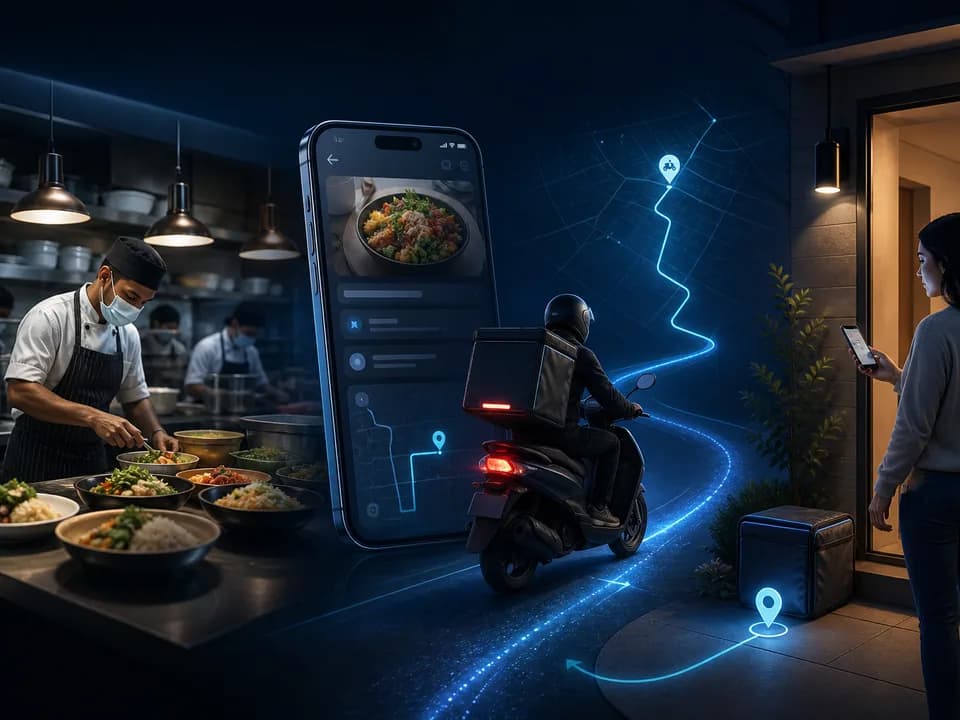
Food delivery app development creates the connected software that lets customers discover food, restaurants manage accurate menus and orders, couriers complete lawful delivery work, and operations teams resolve exceptions. The visible customer app is only one surface. A dependable product also needs merchant tools, dispatch logic, courier workflows, support controls, payment and refund orchestration, auditable administration, integrations, observability and a clear operating model.
Skillonit's Food Delivery App Development service can cover product discovery, experience design, native or cross-platform apps, responsive web ordering, restaurant and courier applications, administration and support portals, APIs, integrations, quality engineering, migration, release and maintenance. The design may support one restaurant brand, a restaurant group, a managed delivery fleet, a marketplace, a corporate meal programme or a hybrid model. Scope must name who sells the food, who delivers it, who handles money, who owns menu and allergen information, and who is responsible for local operational and legal decisions.
Software cannot prove that food was prepared safely, that a restaurant's ingredient statement is complete, or that a courier will arrive at a promised time. Skillonit does not operate restaurants, certify food, make delivery-time commitments, act as a payment institution, give tax or legal advice, or claim local offices through this page. Examples are design patterns rather than client stories. Buyers should appoint qualified food-safety, legal, tax, privacy, payments, labour and accessibility owners for every intended market.
Direct answer
Food Delivery App Development is the design and engineering of customer ordering, restaurant operations, courier fulfilment, dispatch, payment, support and administration software for food delivery or pickup. A complete platform can manage structured menus, modifiers, availability, discovery, cart pricing, checkout, order acceptance, preparation status, assignment, tracking, delivery evidence, cancellations, refunds and service recovery. It connects those workflows through explicit state machines rather than treating an order as one mutable status.
The principal engineering outcome is dependable coordination among several parties that hold different truths. The restaurant is authoritative for what it can prepare. The payment provider is authoritative for authorization, capture and refund state. The dispatch service is authoritative for courier assignment. The mapping provider supplies route estimates, not promises. The platform owns the customer-facing order record and must reconcile it against those sources. When a system cannot distinguish “requested,” “accepted,” “authorized,” “prepared,” “collected” and “delivered,” operational errors become customer-visible quickly.
A professional engagement should produce an operating-model brief, participant and permission matrix, menu and order data models, price and money-flow rules, order and delivery state machines, integration contracts, threat and privacy analysis, accessibility requirements, exception playbooks, test evidence, release controls, dashboards and handover documentation. Cost and schedule depend on marketplace complexity, restaurant integration, dispatch sophistication, payment and refund scope, supported regions, migration quality and operational service levels—not simply the number of screens.
Product models, participants and ownership
A food delivery product can take several forms. A direct restaurant application serves one brand and may use the restaurant's own staff or a contracted logistics provider. A multi-brand group can share identity and payment while separating menus, locations and operations. A marketplace presents independent merchants and may orchestrate orders, commissions and delivery. A logistics-only product receives orders from external sources and focuses on dispatch. A corporate meal platform may add budgets, eligibility and invoicing. These models require different contracts and system boundaries.
Participants normally include customers, restaurant managers, kitchen or front-of-house staff, couriers, dispatchers, support agents, finance users, catalogue operators and platform administrators. Marketplace restaurants are tenants, not merely tags on orders. Tenant-aware authorization must prevent one restaurant from seeing another restaurant's menu drafts, orders, settlements, staff or analytics. Support access should be scoped, time-bound where practical and logged.
Ownership questions should be answered before design. The restaurant or its authorized operator normally owns menu availability, ingredients and preparation facts. The platform may normalize presentation but should preserve provenance. The seller of record, merchant of record and delivery provider determine receipts, tax, refunds and support duties. The buyer's legal and finance teams must decide these roles; software implements approved decisions and preserves evidence.
The customer journey includes address eligibility, discovery, item configuration, cart, review, payment, tracking, delivery and aftercare. The restaurant journey includes onboarding, hours, menus, capacity, acceptance, preparation, handoff and issue response. The courier journey includes availability, offer, acceptance, navigation, pickup confirmation, delivery and earnings or settlement visibility when in scope. Support needs a unified timeline without excessive access to sensitive data. Administrators need policy and configuration control with strong audit.
A custom application is appropriate when ordering experience, menu complexity, restaurant operations, logistics or data ownership differentiates the business. A commercial ordering platform can be preferable for standardized single-location needs. A responsive web application may cover occasional customers better than forcing an install. Custom engineering should not be commissioned merely to reproduce an existing marketplace without a distribution, operations and economics plan.
Food delivery app use cases
The following use cases illustrate requirement patterns. They are not Skillonit client claims, restaurant partnerships, delivery results or evidence of approval in any jurisdiction.
Direct ordering for a restaurant brand
A restaurant group can offer delivery and pickup across its locations. Address or branch determines the eligible menu, price, tax, hours and capacity. Orders can flow to a restaurant tablet, POS or kitchen display. The system freezes the accepted commercial snapshot; later unavailability follows an approved substitution, cancellation or refund workflow rather than silently changing paid items.
Multi-restaurant marketplace
A marketplace adds merchant onboarding, contracts, commissions or settlement, catalogue review, tenant isolation and multi-party support. It must identify whether each restaurant supplies a courier or uses a shared fleet. Ranking can use supportable eligibility, relevance and availability signals; sponsored placement is labeled under the approved policy.
Managed fleet and dispatch
A network or logistics operator can dispatch eligible work using location, capacity, vehicle rules and workload. Operations intervene when a courier declines, loses connectivity or cannot complete delivery. Labour classification, compensation, safety and allocation fairness remain qualified business responsibilities; software exposes reasons and controlled override without claiming legal sufficiency.
Pickup and scheduled ordering
Pickup still needs branch eligibility, capacity, collection identity and late-collection handling. Scheduled orders add cut-offs, capacity and a distinction between requested and confirmed readiness. The server revalidates a slot. Price, tax, promotion, availability and payment timing follow a documented future-order policy.
Corporate meal programmes can add budgets, eligibility, cost centers, approvals and invoicing while separating those states from restaurant acceptance and delivery. White-label products can share a foundation while keeping branding, store accounts, payments and data tenant-specific. Both models add governance and lifecycle cost beyond ordinary ordering.
Customer discovery, address eligibility and account experience
Discovery begins with fulfilment eligibility. A customer may enter an address, allow approximate or precise location while using the app, choose a saved address or select pickup. The server normalizes the address, retains the provider result and evaluates it against delivery zones. Location permission should be requested at the moment it supports a visible feature; browsing can often work with a manually entered area.
An eligible address is more than a point inside a polygon. The model may include entrance instructions, unit number, landmark, access restrictions and geocoding confidence. The customer confirms the pin and text. Support needs to understand corrections without overwriting authoritative order history. Sensitive access notes should be retained only as long as justified.
Restaurant search can use cuisine, name, dish, dietary attributes, fulfilment type, price band, user-selected ratings where real data exists, availability and estimated service range. Search indexes must respect current tenant visibility, region and opening status. A search result should not imply an item is orderable until the server validates location, schedule and stock-like availability.
Ranking rules need product ownership. A practical default combines eligibility, relevance, open state and operational constraints. Personalization can be optional and explainable. The platform should avoid inferred sensitive traits and maintain a non-personalized path where required. Sponsored results, if used, should be clearly identified rather than blended with organic relevance.
Restaurant detail pages show verified merchant-supplied information, fulfilment options, service fees, minimums, hours and menu. Descriptions should not invent food claims. Images require rights and accessible alternative-text guidance. A menu photograph is insufficient as the only data source because it cannot reliably power search, modifiers, prices or accessibility.
Guest checkout can reduce friction, while an account supports saved addresses, order history, preferences and support. The design should not require broad permissions or marketing consent to place an ordinary order unless the operating model genuinely needs them. Account deletion must distinguish deletable profile data from order, payment, tax or dispute records retained under approved policy.
Restaurant onboarding and location operations
Restaurant onboarding gathers legal and operational data approved for the business model: entity and contact information, fulfilment locations, hours, service zones, payment or settlement configuration, menu ownership, support contacts and user roles. Any verification process belongs to a named operational and legal policy. A submitted document is not automatically proof of legitimacy.
Each restaurant location has its own timezone, service hours, closures, order channels, capacity, printer or display devices and handoff instructions. Holiday schedules and exceptional pauses override regular hours. The system makes the precedence visible so a restaurant can understand why orders are unavailable. Timezone calculations happen on the server using named zones, not a fixed offset.
Staff access can include owner, location manager, catalogue editor, order operator, finance viewer and support liaison. Invitations expire and are revocable. Actions such as changing payout configuration, publishing a menu, issuing a refund or revealing customer contact data may require stronger authorization. Staff departures should remove all location access centrally.
The order console prioritizes new orders, expiring acceptance decisions, preparation progress, courier arrival and exceptions. Audible alerts need a visual equivalent. A background tablet cannot be assumed to receive every push, so the application reconnects, retrieves authoritative pending work and alerts the operator. A printer receipt is an aid, not the sole record.
Capacity controls can limit concurrent orders, pause delivery, lengthen preparation estimates or disable specific items. They should be explicit and auditable. An algorithm may recommend capacity changes, but restaurant operators need understandable controls and the platform needs safeguards against accidental closure across all tenants.
Menu, modifiers and availability modelling
A normalized menu contains versions, categories, items, variants, modifier groups, modifier options, prices, tax references, availability schedules, fulfilment eligibility, images and merchant-supplied food information. An item can appear in several categories without being duplicated. Menu publication creates an immutable version reference so accepted orders remain explainable after edits.
Modifiers require rules, not free text. A pizza may require one size, permit up to three toppings and offer mutually exclusive crust options. A meal may include repeated choices with quantity limits. The cart validates minimum and maximum selection, dependencies and price deltas on the server. Accessible labels describe what is required, selected and charged.
Combos and bundles need a component model. If a restaurant replaces a side or sells out of one component, the platform follows a defined substitution or unavailability rule. It should not silently remove paid components. Quantity and inventory-like flags can be managed locally or synchronized from a POS, but the source and freshness must be clear.
Availability can depend on location, day, local time, channel, fulfilment method, capacity and manual pause. An item visible during browsing may become unavailable before checkout. The server re-prices and revalidates the full cart and returns a human-readable difference. It never relies solely on an old client-side flag.
Menu publication should support draft, review, scheduled publish, published and retired states. Marketplace moderation can check prohibited content and completeness under an approved policy. A rollback restores a known version without rewriting historical orders. Bulk import requires preview, validation and row-level error reporting rather than partial silent success.
Ingredient, allergen, dietary and nutrition facts are safety-relevant. The restaurant or another explicitly designated qualified source must own their accuracy and updates. The platform stores provenance, last confirmation and disclaimers approved for the market. A “vegan,” “gluten-free” or allergen filter must not be inferred from an item name. Cross-contact cannot be ruled out through software. Customers with an allergy should receive an appropriate route to verify information with the restaurant under the buyer's policy.
Regulatory requirements differ. For example, official FDA material discusses major allergens and notes that information requirements vary by product and context in the United States. That fact does not establish the correct implementation in another country or for every restaurant. Qualified local review determines labels, disclosures, records and update processes.
Cart, pricing, fees, tax, tips and promotions
The cart is a server-validated commercial proposal. It contains restaurant, fulfilment location, menu-version references, configured items, quantities, item prices, discounts, fees, tax inputs, tip, currency and expiration or freshness. The client may calculate a preview for responsiveness, but checkout uses the server result and explains material changes.
Multi-restaurant carts create operational and financial complexity. The simplest model limits a cart to one restaurant. A combined cart may actually create several orders, payment allocations, delivery tasks and refund paths. If combined ordering is commercially required, the interface must explain separate timings, fees and cancellations.
Pricing rules should use integer minor units or a decimal money type, never binary floating-point arithmetic. Every amount has a currency. Rounding happens according to an approved policy at defined boundaries. The receipt can reconstruct subtotal, item modifiers, promotion, delivery fee, service fee, small-order fee, tax, tip and total.
Delivery fees can depend on zone, distance, demand, order value or a published rule. A quoted fee must be revalidated without hidden additions. If dynamic pricing is used, the business defines disclosure, fairness and legal controls. Engineering makes the calculation versioned and testable; it does not decide whether a pricing policy is permissible.
Tax calculation may be provided by a restaurant, commerce platform, tax service or finance rules. The authority is explicit. Food, delivery and service charges can receive different treatment by jurisdiction. Skillonit can integrate a buyer-selected tax source but does not determine tax liability. Receipts follow the seller-of-record and local requirements approved by qualified advisers.
Tips should be voluntary where required, visible and attributed to the intended recipient under the operating model. Defaults, post-delivery adjustment and distribution need policy review. The ledger separates tip from restaurant proceeds, platform fees and tax. The interface must not use coercive or misleading choice design.
Promotion rules include eligibility, code, date window, restaurant, items, fulfilment type, minimum spend, redemption limit and funding source. Rules are evaluated centrally and recorded with the order. Conflicts use explicit priority. A refund defines how discounts and funded contributions reverse. Anti-abuse signals can limit repeated redemptions while preserving accessible support for false positives.
Checkout, payments and financial reconciliation
Checkout confirms address, contact channel, fulfilment time, item configuration, commercial breakdown, merchant identity, restaurant instructions and payment method. The final action communicates that an order or payment obligation will be submitted. Accessibility and localization are particularly important because errors have immediate cost.
Payment architecture should minimize card-data exposure by using a reputable payment service provider's hosted or tokenized mobile components. Payment credentials should not pass through general application logs. The buyer, merchant, provider and qualified assessor determine the applicable payment-security scope; using a provider does not automatically remove all responsibilities.
Payment timing differs by model. A platform may authorize at checkout and capture after restaurant acceptance, capture immediately with a defined refund process, or use another approved sequence. Some payment methods do not support identical behavior. The order state and payment state remain separate so “restaurant rejected” can trigger the correct void or refund without pretending the result is instantaneous.
Submission uses an idempotency key tied to the checkout intent. A timeout does not justify charging again. The backend queries the provider or waits for an authenticated event before offering retry. Payment webhooks are verified, replay-protected and processed idempotently. The provider reference and application intent enable reconciliation.
Refunds can be full or partial for rejection, missing item, quality complaint, failed delivery or support adjustment according to policy. The operator sees refundable amount, previous refunds, promotion allocation, tax and tip treatment. The platform records reason, actor, evidence reference and provider result. “Refund submitted” is distinct from “funds returned,” and provider arrival ranges are presented as non-binding estimates.
Marketplace settlement adds restaurant earnings, commissions, delivery compensation, tips, fees, taxes, adjustments and provider transfers. A finance subledger or controlled provider reporting workflow should support balanced reconciliation. The consumer order record is not a sufficient accounting ledger. Daily reconciliation compares application intents, provider payments, refunds and settlement reports and routes discrepancies for investigation.
Cash on delivery, if lawfully offered, requires collection, change, courier custody, fraud and reconciliation policies. It is not just another payment enum. The buyer must define liability and safety. The system tracks expected and confirmed collection while avoiding unnecessary display of cash exposure.
Order lifecycle and exception state machines
An order should have a documented state machine. A representative flow can include cart, checkout-created, payment-pending, placed, restaurant-pending, accepted, preparing, ready, courier-assigned, collected, arriving, delivered, completed, rejected, cancelled or exception. The actual model can use parallel restaurant, payment and delivery states instead of one overloaded status.
Every transition names its actor, preconditions, timestamp, payload, side effects and reversal path. The customer cannot cancel after a configured operational milestone without invoking a policy. The restaurant cannot mark collected unless a courier or pickup handoff is eligible. Support actions do not rewrite history; they append an adjustment or corrective event.
Optimistic screens can show “submitting” but should not show “accepted” before server confirmation. Duplicate taps, retried webhooks and reconnecting devices must converge on one order. An append-oriented event timeline with stable identifiers helps explain decisions, while current projections make reads efficient.
Restaurant acceptance can be automatic under approved capacity rules or explicit. The system sets a decision deadline and escalates when the restaurant device is offline. It should not silently accept merely because a push was sent. If acceptance fails, the customer receives an accurate state and the payment follows the approved void or refund process.
Preparation estimates begin as operational forecasts. The restaurant can update them within policy. Courier dispatch can occur before or after preparation milestones depending on travel and wait strategy. Customer-facing time ranges are derived from current data and labeled as estimates, never guaranteed delivery commitments.
Exception types include restaurant unresponsive, item unavailable, payment uncertain, no courier, courier delayed, incorrect address, customer unreachable, failed handoff, missing item, duplicate order and provider outage. Each has an owner, customer communication, financial treatment, operational escalation and closure evidence. Generic “something went wrong” is inadequate for support and reconciliation.
Dispatch, courier and delivery execution
Courier onboarding and eligibility are governed by the buyer's labour, identity, vehicle, insurance and safety policies. The application can collect approved information and show review state, but it does not determine legal worker classification or certify an individual. Couriers should understand data use, location collection, offer logic and support channels.
Availability indicates willingness to receive work, not guaranteed assignment. A courier offer can show pickup, approximate drop area where appropriate, expected distance or time, compensation information required by policy and acceptance window. Sensitive customer details are withheld until needed. Decline behavior and automated allocation require fairness and labour review.
Dispatch considers restaurant readiness, courier position, vehicle and capacity, delivery zone, current tasks and service policy. Simple nearest-courier rules can create excessive restaurant waiting or ignore existing routes. Batch or stacked deliveries add temperature, timing, order sequencing and customer-expectation risks. Optimization objectives must be explicit and constrained by operations.
Assignment is concurrency-sensitive. Two couriers cannot both win the same task. The server uses a reservation, version or transactional compare-and-set, then informs unsuccessful devices. Reassignment retains the history. Dispatcher override requires reason and permission.
Courier navigation can deep-link to a mapping provider or embed a route experience. Mapping results are estimates affected by traffic, access and provider coverage. The application should not direct unsafe or prohibited behavior. Couriers need a way to report incorrect entrances, closures or hazards without altering a customer's permanent address automatically.
Background location may support active delivery tracking, but it should be collected only when necessary, disclosed and controlled. Apple requires location use to be relevant and explained; Android advises that background access be critical to core functionality and makes it subject to platform restrictions. The courier interface shows when tracking is active. The customer receives an appropriately reduced location view rather than unrestricted courier history.
Battery, network and device conditions make continuous tracking unreliable. The system stores timestamp and accuracy, handles sparse points and labels stale tracking. It must not fabricate smooth motion that implies certainty. Geofence events are signals, not proof of pickup or delivery by themselves.
Pickup confirmation can use an order code, QR scan or restaurant acknowledgement. The workflow confirms the correct packages and any drinks or extras without exposing customer secrets. Handoff evidence should be proportionate and accessible. A restaurant staff member can report a courier mismatch or packaging issue before collection.
Delivery proof may use customer confirmation, one-time code, photograph, signature or location-supported record according to policy. Photographs can capture homes, faces or other sensitive details and require clear collection, access and retention rules. Contactless drop-off instructions need a failure path when the location is unsafe or unclear. Proof is evidence for review, not an absolute guarantee that the correct person consumed the order.
An unsuccessful delivery can trigger attempted contact, approved waiting, safe-return or disposal instructions and support escalation. The courier should never be encouraged to take unsafe action. Financial and compensation treatment follows the operator's policy and applicable law.
Notifications, communication and support
Notifications communicate meaningful transitions such as order accepted, preparation update, courier assigned, approaching delivery, delivered, cancellation or refund submitted. Push delivery is best-effort. The authoritative timeline remains in the app, and critical action should not depend on one push message.
Messages should minimize sensitive content on lock screens. Customers choose optional marketing separately from transactional communications where required. SMS or email fallback needs consent, verified contact data and provider failure handling. Templates are localized and versioned.
Masked calling or in-app chat can help customers, couriers and restaurants resolve access questions. Participants see only the conversation and identity information necessary for the active order. Attachments, abusive content, spam and retention require moderation and safety rules. Messaging is not an emergency service.
Support agents need an order timeline that reconciles customer, restaurant, courier, payment and notification events. Tools can include resend notification, correct limited contact information, record an issue, initiate an approved refund, reassign delivery or escalate. Each action is permissioned and audited. Support should not ask customers for full payment credentials, passwords or one-time authentication secrets.
Issue categories and resolution codes enable operations learning, but a code should not replace narrative or evidence for complex disputes. Service recovery can include a refund or promotion only within approved limits. Automated compensation should protect against abuse and allow review of incorrect denials.
Customer feedback can be requested after a confirmed outcome and tied to a genuine transaction. The product should never invent ratings or testimonials. Restaurant, courier and item feedback have different privacy and employment implications. Moderation, appeal and publication rules require named ownership.
Food delivery app architecture
A pragmatic architecture usually includes customer, restaurant and courier clients; administrative and support web applications; an API gateway or backend-for-frontend; identity and authorization; restaurant and menu services; search; cart and pricing; order orchestration; payment adapters; dispatch and delivery; notification; support; audit; analytics and observability. Team size and scale determine whether these are modules in a well-structured application or independently deployed services.
A modular monolith can be the right beginning when domain boundaries are still evolving. It provides transactional consistency and simpler operations. Microservices can help independent high-volume domains or teams, but distributed workflows introduce versioning, event ordering, observability and reconciliation work. Architecture should respond to measured constraints rather than the prestige of a pattern.
The mobile clients treat the server as authority for eligibility, price, order transitions and permissions. A backend-for-frontend can provide surface-specific views while domain services enforce business rules. The client stores the minimum needed, protects tokens with platform facilities and clears scoped data appropriately.
Relational storage suits orders, prices, payments, restaurant configuration and permissions because constraints matter. Search indexes support discovery but are derived from catalogue truth. Geospatial storage supports zones and candidate retrieval. Object storage can hold approved menu and delivery images with access controls and lifecycle policies. A cache improves menu and restaurant reads but must not bypass current availability at checkout.
Event-driven processing is useful for notifications, search indexing, analytics, restaurant integration and operational projections. Events carry stable identifiers, version and time. Consumers are idempotent. An outbox or equivalent pattern reduces gaps between database changes and event publication. Material workflow completion is reconciled rather than assumed from event delivery.
Order orchestration can use a durable workflow or explicit state machine. It coordinates payment, restaurant and delivery actions without pretending they share one database transaction. Compensating actions—void payment, release courier reservation, cancel kitchen request—are defined and observable. Manual intervention is a supported state, not a hidden database edit.
Multi-tenancy can use shared tables with enforced tenant keys, separate schemas or dedicated environments for specific customers. The choice depends on isolation, scale and contractual requirements. Authorization and automated tests must prove tenant boundaries regardless of storage pattern. Tenant context comes from verified identity and assignment, never a client-supplied restaurant ID alone.
Availability design identifies service objectives and degradation modes. If personalized recommendations fail, eligible restaurant browsing can continue. If search indexing lags, direct restaurant access may still work. If payment state is uncertain, the system pauses rather than charges again. If dispatch is unavailable, new order acceptance may need controlled restriction. Graceful degradation must preserve money and safety boundaries.
Integrations and data flows
Restaurant integrations can include point-of-sale, kitchen display, menu, inventory-like availability, loyalty, customer relationship and finance systems. A canonical internal model maps provider-specific fields without erasing provenance. Provider adapters have versioned contracts, timeouts, rate-limit handling, signature checks, idempotency and reconciliation.
POS integration direction must be explicit. The POS may own menu and prices, the platform may own the delivery catalogue, or responsibilities may be split. Bi-directional updates without field ownership create loops and unexplained overwrites. Publication reports unmapped modifiers, invalid taxes and rejected products before they affect customers.
Order injection into a POS needs an acknowledgement and provider reference. A successful HTTP response does not necessarily mean the kitchen accepted the order. Polling or provider events retrieve actual state. If POS delivery fails, a restaurant console or operational fallback can prevent silent order loss. Duplicate injection is prevented with stable external keys.
Mapping integrations may provide geocoding, autocomplete, routing, distance matrices and map display. Terms, attribution, data retention and regional coverage must be reviewed. Address autocomplete is not proof of deliverability. The platform applies its zone and operational rules after geocoding and lets users correct ambiguous results.
Payment provider integrations use provider-supported mobile components, server APIs and authenticated events. Wallet payment methods, local methods, stored credentials, disputes and marketplace settlement vary. Provider names should appear only after selection; mentioning an integration pattern is not a partnership claim.
Identity providers can support customer sign-in or enterprise workforce access. Restaurant and admin roles still require application authorization. Notification providers deliver push, SMS or email, but delivery receipts have different meaning. Analytics platforms receive minimized events and should not receive raw addresses, access instructions or payment details by default.
Webhook receivers validate the provider and expected tenant, enforce replay and size limits, store a receipt identifier and process idempotently. Outbound webhooks can be signed and retried with a bounded policy. A delivery log shows customers which events were accepted without exposing secrets.
Data-flow documentation should trace customer identity, address, location, menu facts, cart, order, payment token, courier location, support attachments and analytics. Each flow names controller or owner, purpose, recipient, retention, region and deletion or legal-hold behavior. This becomes the basis for privacy and security review.
Security, privacy, fraud and food-information boundaries
Security begins with an inventory of assets and actors: customer accounts, restaurant administration, courier identity, addresses, live locations, payment tokens, order histories, menu publishing, promotions, support tools and administrative configuration. Threat modelling examines account takeover, tenant escape, price manipulation, duplicate payment, fraudulent refund, courier spoofing, scraping, fake restaurant onboarding and privileged misuse.
Authentication can use passkeys, federation or appropriately protected credentials. High-risk changes such as payout details, administrator roles or refund limits may require step-up authentication and independent review. Recovery is designed as carefully as sign-in. Sessions and devices can be revoked.
Authorization is server-side and resource-specific. A restaurant staff member sees assigned locations, a courier sees only necessary active-delivery information, and support sees data required for a case. Role-based access can be supplemented with relationship and state checks. Every administrative request derives tenant context from trusted identity.
Sensitive data is encrypted in transit and at rest using maintained platform and cloud controls. Secrets reside in a secret manager, not source code or mobile configuration. Key rotation, backup access and administrative authentication are operational responsibilities. Encryption is not a blanket security guarantee.
Payment data scope is minimized through tokenization and hosted provider components. Logs redact payment tokens, authorization headers, exact location and free-form access instructions. Production access uses least privilege, strong authentication, approval and audit. Non-production uses synthetic or appropriately de-identified data.
Fraud controls can identify velocity, device or account anomalies, promotion abuse, suspicious location patterns, repeated refund behavior and restaurant or courier inconsistencies. Signals feed a governed decision or review process. The system must allow correction of false positives and avoid claims that it prevents all fraud. Rules and models are monitored for performance and disproportionate impact.
Privacy design practices data minimization and purpose limitation. Precise courier location is collected during an active work purpose under the approved model, not indefinitely. Customer address and instructions are visible only when needed. Restaurant analytics should not expose individual courier histories without a lawful, defined purpose. Retention is set per data class and jurisdiction.
Food facts require a distinct ownership boundary. Engineering can validate required fields, preserve versions, highlight missing data and show merchant-confirmed information. It cannot inspect a kitchen, detect cross-contact, verify ingredients or guarantee a dietary claim. The restaurant and qualified business owners remain responsible for accurate source data and safe preparation. The interface should communicate uncertainty and provide a contact route rather than convert absent data into “allergen free.”
Security testing follows the identified risks and can reference OWASP mobile and application verification guidance. Dependencies, mobile SDKs and infrastructure are inventoried and scanned. Penetration testing scope includes APIs and privileged portals, not just customer screens. Findings are triaged and retested. No page should describe an unperformed test or certification as fact.
Incident readiness covers account abuse, data exposure, payment discrepancy, unavailable ordering, incorrect menu publication and malicious support activity. Food-safety incidents and delivery emergencies require separate operational procedures led by qualified owners. Software can preserve records and route reports but is not an emergency response service.
Accessibility, localization and inclusive delivery
Accessibility should target the buyer's approved standard, commonly WCAG 2.2 AA for relevant web surfaces, while mobile teams test platform semantics and assistive technology. Customer, restaurant and courier flows all matter. An inaccessible courier or restaurant console can block a worker from completing essential tasks even if the customer app is polished.
Controls have programmatic names, roles, states and errors. Menu modifier groups announce selection requirements. Price changes are communicated in text rather than color alone. Focus moves predictably after cart updates. Dynamic order status uses appropriately restrained announcements so a screen reader user is informed without being overwhelmed.
Touch targets, text scaling, contrast and orientation are tested on real devices. Map-only information has a list or textual alternative. A delivery pin is paired with a readable address and instructions. Gestures have alternatives. Time-limited offer or checkout steps account for accessibility and do not expire without warning or an appropriate extension policy.
Images need meaningful alternative text written from the product context. Decorative food images can be ignored, while an image conveying item identity needs concise text. Allergen and ingredient facts must be available as actual text, not embedded solely in an image or PDF.
Localization covers language, pluralization, text expansion, right-to-left layouts, address format, telephone format, date, time, number and currency display. Money calculation remains currency-safe on the server. Restaurant names and menu terms may need merchant-controlled translations with provenance. Machine translation should not silently translate safety-critical ingredient or allergen facts without approved review.
Delivery language should be respectful and clear. Couriers need understandable safety and issue actions under motion and time pressure. Customers need a low-cognitive-load path to report missing or incorrect items. Research should include people using assistive technologies and users with varied language and digital experience.
Performance and Core Web Vitals
Performance directly affects ordering completion and restaurant operations. Mobile budgets can cover cold start, interaction latency, network payload, image memory, battery and data use. Web ordering should target current Core Web Vitals guidance for Largest Contentful Paint, Interaction to Next Paint and Cumulative Layout Shift under realistic mobile conditions.
Menu payloads are paginated or sectioned, images are resized and delivered in modern formats, and caches respect tenant and locale. Critical restaurant and order data loads before secondary recommendations. Skeletons reserve space to avoid layout shift. Analytics and marketing SDKs are governed because they can increase startup, privacy risk and failure surface.
Search indexes and restaurant lists can be cached, but address eligibility, availability and final price are revalidated. Cart operations should feel immediate while clearly resolving server changes. A slow payment response shows a stable processing state and prevents repeated submission.
Courier tracking is bandwidth- and battery-aware. Update frequency can respond to trip state and platform restrictions. The server accepts out-of-order points safely and retains accuracy metadata. Customer maps reduce update and marker work when the app is backgrounded or the order is not visible.
Load tests model meal-time bursts, popular restaurant promotions, simultaneous restaurant acceptances, map-provider throttling and notification fan-out. Average latency is insufficient; teams examine high percentiles, error rates and queue age. Capacity tests include administrative and restaurant tools, since a failure there can strand paid orders.
Performance observability separates client, API, database, provider and event delays. Order and payment identifiers are correlated without logging secrets. Budgets become release gates where practical. Optimization follows measured bottlenecks rather than unsafe removal of validation or audit.
Technical SEO
Public restaurant, cuisine, location and service pages require a deliberate SEO architecture. This global service authority page has one canonical path, /services/food-delivery-app-development/. Its title, description, H1, breadcrumb and Service schema candidate describe the same service. FAQ structured data may be emitted only for visible FAQs that meet search-engine policy.
Restaurant ordering content has different indexability rules from Skillonit's service marketing pages. If a delivered product exposes public restaurant menus, the buyer must define canonical identities for restaurant locations and items, handle unavailable content honestly, prevent filter and search parameter crawl traps, and keep private carts, accounts, orders and support cases out of search. Structured data must reflect visible, verified content rather than invent ratings, delivery times or offers.
Mobile-first rendering should expose meaningful content without requiring a search bot to perform account actions. Links have descriptive anchors. Images use optimized dimensions and accurate alternative text. Redirects, status codes, robots rules and XML sitemap eligibility are tested. Sitemap lastmod must reflect meaningful source updates, not a deployment timestamp applied to every URL.
Hreflang is appropriate only for fully translated, editorially reviewed equivalents with reciprocal references. A country or city name inserted into English copy does not make a localized equivalent. An x-default can point to the genuine global selector or default authority page when that architecture exists.
Answer-engine readiness comes from a concise definition, clear headings, explicit ownership boundaries, comparison tables, factual source notes, visible update metadata and consistent entities. It does not require keyword repetition. No implementation can guarantee rankings, snippets, AI citations, traffic or leads.
International country and city page safeguards
Potential location modifiers include “Food Delivery App Development company in [country]” and “Food Delivery App Development services in [city].” They are research intents, not permission to publish millions of near-duplicate pages. The national/global authority page and local routes remain separate and can link to one another when useful.
An unreviewed country or city route must remain contentStatus: editorial_review, robots: noindex,follow and sitemapEligible: false. It should use deterministic country and city identifiers from the approved worldwide dataset. It must not imply a Skillonit office, restaurant network, courier fleet, local licensing, assured local availability or regulatory approval.
A location page can become indexable only after human review confirms substantial local value: relevant restaurant and logistics market context, verified service-delivery model, language, currency, timezone overlap, applicable payment and mapping availability, locally reviewed food, labour, privacy and commerce considerations, unique questions and an accurate conversion path. Country law cannot be inferred from a neighboring market.
Local keyword and entity maps guide research but should not become awkward exact-match copy. Every claim needs a source and review date. Similarity checks compare location pages with the global page and one another. Routes that merely swap the place name remain noindex and outside XML sitemaps.
Hreflang is added only when a translated page is real, reciprocal and approved. Canonicalizing every local page to the global page while publishing contradictory localized structured data is avoided. A self-canonical local page becomes eligible only after the location-quality and editorial gates pass.
Discovery-to-launch delivery process
1. Operating-model and outcome discovery
Discovery identifies the restaurant model, commercial roles, delivery responsibility, customers, regions, channels, volume and service windows. Product, operations, logistics, finance, support, security, privacy, accessibility and qualified legal or food-safety owners turn assumptions into decisions. Outputs include journeys, a responsibility and source-of-truth matrix, risks, metrics definitions and phased scope.
2. Domain and policy definition
The team models locations, menus, carts, prices, orders, payments, delivery and support. Owners define cancellation, substitution, refund, dispatch, food-information, location and retention policies. Prototypes cover the ordinary flow plus unavailability, rejection, uncertain payment, missing courier, incorrect address and failed handoff.
3. Experience and technical design
Design covers customer, restaurant, courier and support journeys with accessibility criteria. Architecture records clients, services, stores, events, tenancy, failure modes, controls and monitoring. Non-production proofs test POS capabilities, payment events, background location and menu scale before schedule confidence is claimed.
4. Incremental implementation
Vertical slices connect API, clients, permissions, audit, tests and monitoring. A first slice can publish a menu, place and accept a test order and update the customer; later slices add payments, dispatch, couriers, support and migration. Feature flags, test tenants, synthetic restaurants and versioned policy copy enable safe iteration.
5. Verification and operational readiness
Release candidates undergo functional, device, accessibility, performance, security, resilience and reconciliation testing. Restaurant, courier, support and finance teams rehearse realistic exceptions. Runbooks cover provider outages, uncertain payment, missed acknowledgement, dispatch backlog and incorrect catalogue publication. Owners sign off on limitations and disclosures.
6. Controlled launch and learning
Launch begins with controlled restaurants, zones, hours and users, with pause and rollback controls for active orders. Technical health and operational exceptions inform expansion. Changes to fees, ranking, courier allocation or safety-relevant information receive appropriate governance.
Testing and quality assurance
Unit tests cover modifier rules, menu schedules, money rounding, promotion eligibility, order transitions and permission policies. Property-based tests can explore price invariants: totals reconcile, quantities remain valid, refunds never exceed approved refundable amounts and repeated commands do not create additional effects.
API contract tests cover customer, restaurant, POS, payment, mapping, dispatch and notification boundaries. Provider fixtures include timeout, duplicate event, delayed event, invalid signature, rate limit and changed schema. Sandbox success is not enough; production readiness includes provider-specific certification or review where applicable and carefully controlled live verification.
End-to-end tests follow placed, accepted, rejected, cancelled, prepared, assigned, collected, delivered and refunded orders. They also test concurrent changes: last item sold while two carts check out, restaurant closes while an order is pending, two couriers accept one offer, and a payment webhook arrives before the client response.
Device coverage reflects supported iOS and Android versions, screen sizes, memory classes, OS language, text size, dark mode and assistive technologies. Restaurant tablets, courier devices and poor-connectivity conditions receive their own matrix. Tests include permission denial, approximate location, background restriction, low battery, process termination, timezone change and app upgrade during an active order.
Accessibility tests combine automated checks with keyboard, VoiceOver, TalkBack, text scaling, contrast and user evaluation. Payment, modifier selection, tracking and issue reporting receive particular attention. A passed scanner is not accessibility certification.
Performance tests model browse and checkout traffic plus restaurant, dispatch and courier workloads. Resilience tests isolate provider delays and queue backlogs. Security tests cover authorization, tenant isolation, injection, session handling, mobile storage, webhook forgery, price tampering, promotion abuse and privileged workflows.
Reconciliation tests compare order, payment, refund and settlement records. Migration tests verify menu versions, locations, customer consent and open orders. Acceptance evidence maps requirements to test results, known limitations and named approvals. Defects involving money, tenant isolation, food-information display or active-order integrity block release under an approved severity policy.
Deployment, release and private operational distribution
Development, test, staging and production have separate access, managed secrets and reproducible infrastructure. Backward-compatible APIs account for users who delay mobile upgrades. Signed pipelines run tests, scan dependencies and preserve approvals; store descriptions, privacy declarations and location-permission purposes match actual behavior.
Customer and courier applications can use public stores under current platform rules. Restaurant tools may use public, managed-device or browser distribution according to device ownership and platform terms. Private channels must not be misused for a public consumer app.
Backend releases use staged traffic or tenant cohorts. Database changes include backup and recovery validation. Rollback considers in-flight orders and events rather than merely reverting code. Mobile monitoring can trigger a feature disablement or compatibility fallback when a critical regression appears.
Observability and live operations
Telemetry covers client failures, API latency, queue age, providers and databases alongside operational states such as unacknowledged orders, uncertain payments, dispatch gaps, stale courier positions and pending refunds. Opaque identifiers correlate traces without placing payment details, secrets or unnecessary personal data in logs.
Actionable alerts route restaurant delay to operations, invalid payment events to security and an event backlog to engineering. A controlled intervention console replaces direct database edits and audits every correction. Technical service objectives guide operations but do not become guaranteed food-arrival claims.
Migration and adoption
Migration can include restaurants, staff, menus, images, customers, consent, promotions and order history. Every field has an owner, format and retention basis. Menu import normalizes modifiers, prices and availability, provides a preview and requires restaurant approval; unverified food facts remain quarantined.
Identity transition uses a lawful basis and secure reset where password hashes are unsuitable. Consent is not inferred, and payment tokens move only through provider-supported methods. Cutover assigns one authority for new orders while explicitly handling open payments, refunds, courier tasks and callbacks.
Restaurants, couriers, support and finance rehearse normal and outage flows. Reconciliation checks counts, prices, access, payment references and open outcomes. Historical order snapshots remain immutable, and old systems are retained or retired under policy rather than deleted merely because launch occurred.
Timeline factors
A direct-ordering pilot with one menu source is smaller than a multi-restaurant marketplace with managed couriers. Discovery and architecture may take several weeks; a narrow customer, restaurant and payment vertical slice can take a few months, while dispatch, settlement and multiple markets add phases. These are planning patterns, not commitments.
Merchant and payment contracts, store accounts, POS sandbox quality, restaurant data, tax decisions, courier policy and accessibility review often determine the critical path. Confidence improves with fixed pilot markets, representative menus, named source systems and agreed order states. Many white-label brands, providers or unresolved information ownership reduce it. A controlled one-region launch can validate operations before complex optimization.
Cost factors
Cost is driven by operating model, client surfaces, menu complexity, tenancy, payments, POS integrations, dispatch, tracking, support, migration, markets and assurance—not screen count. A marketplace adds merchant governance and settlement; managed delivery adds courier, location and operational tooling.
Third-party costs may include maps, payment processing, messaging, identity, monitoring, search, image delivery, stores and POS access. Usage pricing must be modeled at peak volumes. Testing, accessibility, security, performance and reconciliation are real delivery costs rather than optional polish.
An estimate separates discovery, design, engineering, integrations, migration, launch and maintenance. It lists exclusions such as hardware, courier recruitment, legal review, food certification, processing fees or round-the-clock support. Total ownership includes SDK and provider changes, store releases, data operations and incident response.
Maintenance and continuous improvement
Maintenance covers OS and device changes, store policy, dependency and provider versions, security, performance and operational support. A service model defines hours, severity, response, escalation and provider coordination, giving active-order incidents appropriate priority.
Research, support evidence and restaurant or courier feedback inform improvement. Fees, ranking, allocation, tips, dietary information and cancellation experiments receive stronger governance than cosmetic changes. Recurring work includes vulnerability intake, access review, backup tests, retention enforcement and accessibility retesting.
Risks and mitigations
Unclear commercial responsibility: If seller, merchant, delivery and support roles are ambiguous, receipts and refunds will be inconsistent. Mitigation is an approved responsibility and money-flow matrix before implementation.
Inaccurate menu or food information: Stale prices, missing modifiers or unsupported allergen claims can harm users and trust. Mitigation combines authoritative ownership, versioning, restaurant confirmation, validation and safe uncertainty language; software does not certify food.
Duplicate or uncertain payments: Network retries can create double actions. Mitigation uses idempotent intents, provider query, authenticated events and reconciliation before retry.
Restaurant device failure: A push or printer can be offline while customers place orders. Mitigation includes server-side pending queues, reconnect synchronization, visible deadlines, operational escalation and controlled ordering pauses.
Dispatch mismatch: Optimization can assign a courier too early, too late or twice. Mitigation uses explicit objectives, capacity constraints, atomic reservations, freshness-aware location and human override.
Location privacy: Continuous tracking can expose workers and customers. Mitigation minimizes collection to an active purpose, reduces customer views, controls retention and follows platform permission rules.
Provider dependence: Maps, payment, POS or messaging outages can interrupt workflows. Mitigation uses adapters, timeouts, circuit breakers, fallbacks where safe, provider dashboards and manual exception states.
Tenant escape or privilege abuse: Restaurant and support data can cross boundaries. Mitigation uses trusted tenant context, resource checks, automated isolation tests, least privilege and audit.
Premature international pages: Scaled location copy can become misleading doorway content. Mitigation keeps routes noindex and outside sitemaps until substantial verified local review passes.
Unsafe schedule compression: Deferring reconciliation, accessibility or operational tooling creates launch risk. Mitigation uses vertical slices and release gates tied to money, active order, privacy and food-information boundaries.
Comparisons and decision criteria
Custom platform versus commercial ordering platform
A commercial platform may launch faster for standard menus, payment and pickup. It can be the responsible choice when differentiation is modest and provider constraints are acceptable. Custom development provides greater control over experience, integration, dispatch and data, but requires sustained product and operational ownership. The decision should compare lifecycle cost, data portability, provider dependence, required integrations and roadmap—not only first-year fees.
Direct restaurant app versus marketplace
A direct app serves a known restaurant brand and can use existing customer demand. A marketplace must attract customers and restaurants, govern tenants, coordinate commissions or settlements and support multi-party disputes. Marketplace software is not a distribution strategy by itself. Buyers should validate supply, demand and operations before funding complex features.
Responsive web versus mobile applications
Responsive web ordering reduces install friction and can support search discovery. Native or cross-platform apps can provide stronger repeat-use experience, device integration and push communication. Courier background location and operational workflows often benefit from mobile apps. A blended model—web for acquisition, app for repeat customers and dedicated operational clients—can be appropriate.
Native versus cross-platform delivery apps
Native development offers direct platform control for background work, maps and performance. Cross-platform development can share product logic and interfaces across iOS and Android. Neither removes platform-specific permission, store and device testing. The decision depends on interaction complexity, location behavior, team skills, accessibility and release model. See Native Mobile App Development and Cross Platform App Development.
In-house fleet versus logistics provider integration
An in-house fleet gives the operator more control but adds courier, dispatch, safety and settlement responsibilities. A logistics provider can reduce custom operations while introducing commercial and API dependency. A hybrid model needs clear per-order ownership and support handoff. The application should not tell a customer “our courier” when a third party is responsible unless that wording is accurate.
Rules-based dispatch versus optimization
Rules-based assignment is understandable and can suit a pilot. Optimization can consider many constraints but needs good data, objective governance and monitoring. Machine learning is not automatically better. A staged approach starts with transparent rules and introduces optimization after measuring wait, travel, acceptance and exception patterns.
Frequently asked questions
What does Food Delivery App Development include?
It can include customer ordering, restaurant menu and order tools, courier and dispatch workflows, payment and refund orchestration, support, administration, APIs, integrations, testing, release and maintenance. Exact scope depends on the operator's commercial, restaurant and delivery model.
How are menu modifiers handled?
Modifier groups define required and optional choices, limits, dependencies and price changes. The server validates selections against the accepted menu version. Free text alone is not sufficient for complex restaurant configuration.
Who is responsible for allergen and ingredient accuracy?
The restaurant or another explicitly appointed qualified information owner is responsible for authoritative food facts. Software can store, validate, version and display supplied information but cannot inspect preparation or guarantee absence of an allergen or cross-contact.
Does the app guarantee delivery times?
No. It can calculate and display estimates from restaurant, dispatch, map and courier signals. Traffic, preparation, access, weather, provider data and other conditions can change. Product language should distinguish an estimate from a commitment.
How does live courier tracking work?
The courier app can send location during an active delivery under approved permissions. The server stores freshness and accuracy, and the customer sees an appropriately limited view. Sparse or stale data is labeled rather than interpolated as certainty.
Is background location always required?
No. Customer browsing usually can use a typed address or foreground location. Courier tracking may justify background access during an active trip, but the purpose, platform policy, consent or disclosure, minimization and fallback must be reviewed.
How are refunds handled?
An authorized support or automated workflow creates a full or partial refund intent under policy, submits it idempotently to the payment provider and records the provider state. Submitted is not the same as returned to the customer's account.
Can the app accept cash on delivery?
It can support a buyer-approved cash workflow, but that adds courier custody, safety, change, fraud and reconciliation responsibilities. Local permissibility and operating controls require qualified review.
Can it support scheduled orders and pickup?
Yes. Scheduled availability, capacity, cut-offs, price policy and payment timing need clear rules. Pickup also needs collection identification and late or failed collection handling.
How are taxes calculated?
Taxes can come from an approved restaurant, commerce or tax system. Treatment varies by product, fee, seller and jurisdiction. Skillonit can implement the selected source and calculation contract but does not determine the buyer's tax obligations.
Can the application support tips and promotions?
Yes. Tips and promotions need transparent calculation, eligibility, funding, refund allocation, abuse controls and locally reviewed choice design. The ledger keeps them distinct from tax, restaurant proceeds and platform fees.
Is payment-card compliance guaranteed by using a payment provider?
No. Hosted or tokenized provider components can reduce sensitive-data exposure, but the merchant, provider and qualified assessors determine the applicable scope and evidence. Software delivery does not itself certify compliance.
How long does food delivery app development take?
It depends on the operating model, surfaces, integrations, migration, markets and assurance work. A narrow pilot can be phased earlier than a marketplace with fleet dispatch, settlement and many POS providers. A defensible schedule follows discovery and technical validation.
How much does food delivery app development cost?
Cost depends on customer, restaurant, courier and administrative surfaces; catalogue complexity; payments; maps; dispatch; integrations; migration; security; accessibility; testing and ongoing service. A transparent estimate states assumptions, exclusions and third-party costs.
Can an existing delivery platform be migrated?
Yes, after inventorying restaurants, menu versions, staff, customers, payment tokens, open orders, integrations and retention obligations. Active orders and refunds require a cutover state plan. Unsupported food information should not be published automatically.
Can AI optimize restaurant ranking or dispatch?
AI or optimization can support recommendations after objectives, constraints, data quality, transparency and governance are defined. It should not replace eligibility, food-information ownership, payment controls or human exception handling. Rules may be a better starting point.
Will the app work worldwide?
The architecture can be international, but payment methods, maps, tax, restaurant rules, labour, privacy, food information and language differ. Each market needs verified providers and qualified local review. A global codebase is not automatic worldwide operational approval.
Will city pages be created automatically?
Routes and structured inputs can be generated from the approved geo dataset, but unreviewed pages remain noindex and excluded from sitemaps. Indexation requires substantial unique local information, verified delivery capability, similarity approval and human editorial review.
Does Skillonit operate local restaurants or couriers?
This page makes no such claim. Skillonit provides software development services. Any restaurant, fleet, logistics-provider or office relationship must be separately verified before it appears on a public page.
Related services
Food delivery programmes often need On Demand Service App Development for broader request-and-fulfil patterns, Location Based App Development for consented geospatial workflows, Chat and Messaging App Development for governed participant communication and Ecommerce Mobile App Development for catalogue and checkout foundations.
Teams evaluating client strategy can compare Native Mobile App Development, Cross Platform App Development and Consumer Mobile App Development. Existing products may need App Modernization and Migration rather than replacement. Backends can use API Integration Services where that exact catalogue service is available and verified before publication.
Internal links should be checked against the authoritative catalogue and deployed routes. Descriptive anchors should reflect genuine topical relationships, not force every service into every page.
Start a Food Delivery App Development discussion
Begin with a working session around one representative order: which restaurant owns the menu, how the customer becomes eligible, when price is fixed, who authorizes payment, how the restaurant accepts, who dispatches a courier, what proves handoff, and who resolves an exception. That one journey quickly exposes the required data, integrations, policies and operational ownership.
Skillonit can then shape a phased delivery brief covering customer, restaurant, courier and support experiences; architecture; integrations; migration; security; accessibility; verification; launch and maintenance. The proposal should state assumptions, exclusions, evidence gates and third-party dependencies. It should not promise restaurant participation, delivery time, regulatory approval, rankings or commercial results.
Before publishing or launching, designated human reviewers must validate food-information wording, fees, taxes, payments, courier and labour flows, privacy, location use, accessibility, support, store disclosures and local claims. Until that review is complete, this content remains editorial_review, noindex,follow and outside XML sitemaps.
Editorial source notes
- Apple App Review Guidelines — primary platform guidance for store review, privacy and location-related expectations; current requirements must be rechecked at implementation and submission.
- Android Developers: Access location in the background — primary guidance on necessity, user visibility and technical limits for background location.
- Android Developers: Request background location — primary implementation guidance for permission behavior across supported Android versions.
- FDA: Have Food Allergies? Read the Label — official United States consumer information about major allergen labeling; included to inform ownership and caution, not to prescribe global compliance.
- FDA Food Code Reference System — official United States reference resource; local adoption and applicability require qualified verification.
- PCI Security Standards Council Document Library — authoritative source for current payment-security standards and supporting material; applicable scope and assessment are buyer responsibilities.
- OWASP Mobile Application Security — maintained mobile security verification and testing guidance used as an engineering reference, not a certification claim.
- W3C Web Content Accessibility Guidelines 2.2 — normative accessibility reference for relevant web content and interface criteria.
- Google Search Central: Mobile-first indexing best practices — primary search-engine guidance for mobile-visible content and crawlability.
- Google Search Central: Localized versions — primary guidance for hreflang and international equivalents.
- NIST Secure Software Development Framework — secure development lifecycle reference for organizational engineering practices.
Source notes identify editorial references, not endorsements or partnerships. Versions, regional applicability and provider terms must be checked during discovery and again before release. Facts, recommendations and buyer decisions should remain distinguishable in the reviewed page.